




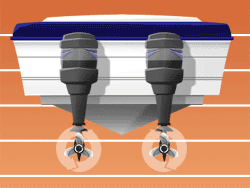
Props spin either clockwise (standard or right-hand rotation) or counter-clockwise (counter or left-hand rotation).
Most single engines use a standard rotation. Most twin engines use one of each. To determine what rotation you have, look at your prop as if on a boat. Position a blade pointing straight up. If the right-hand side of the blade is closer to the hull than to you, it's a standard rotation.
A boat with twin engines and two boat props spinning in the same directionats will have a lot of steering torque. Two right-hand (or standard rotation) propellers pull the stern hard to the right and the bow to the left.
Using both standard and counter rotation with twin engines will eliminate the steering torque. This gives you better straight-Line tracking and helm control at high speeds.
Propeller Help Guide

Propeller Basicss
We tell you everything you need to know about props from cupping to ventilation.

Prop Characteristics
If you want to modify your boat's performance, consider the above before making your selection.

Determining RPM's
For safety and efficient performance, it is critical that your engine operates within the RPM range recommended by the manufacturer.
Propeller Help Guide
Propeller Basicss
We tell you everything you need to know about props from cupping to ventilation.
Prop Characteristics
If you want to modify your boat's performance, consider the above before making your selection.
Determining RPM's
For safety and efficient performance, it is critical that your engine operates within the RPM range recommended by the manufacturer.
Propeller Help Guide
Propeller Basicss
We tell you everything you need to know about props from cupping to ventilation.
Prop Characteristics
If you want to modify your boat's performance, consider the above before making your selection.
Determining RPM's
For safety and efficient performance, it is critical that your engine operates within the RPM range recommended by the manufacturer.